
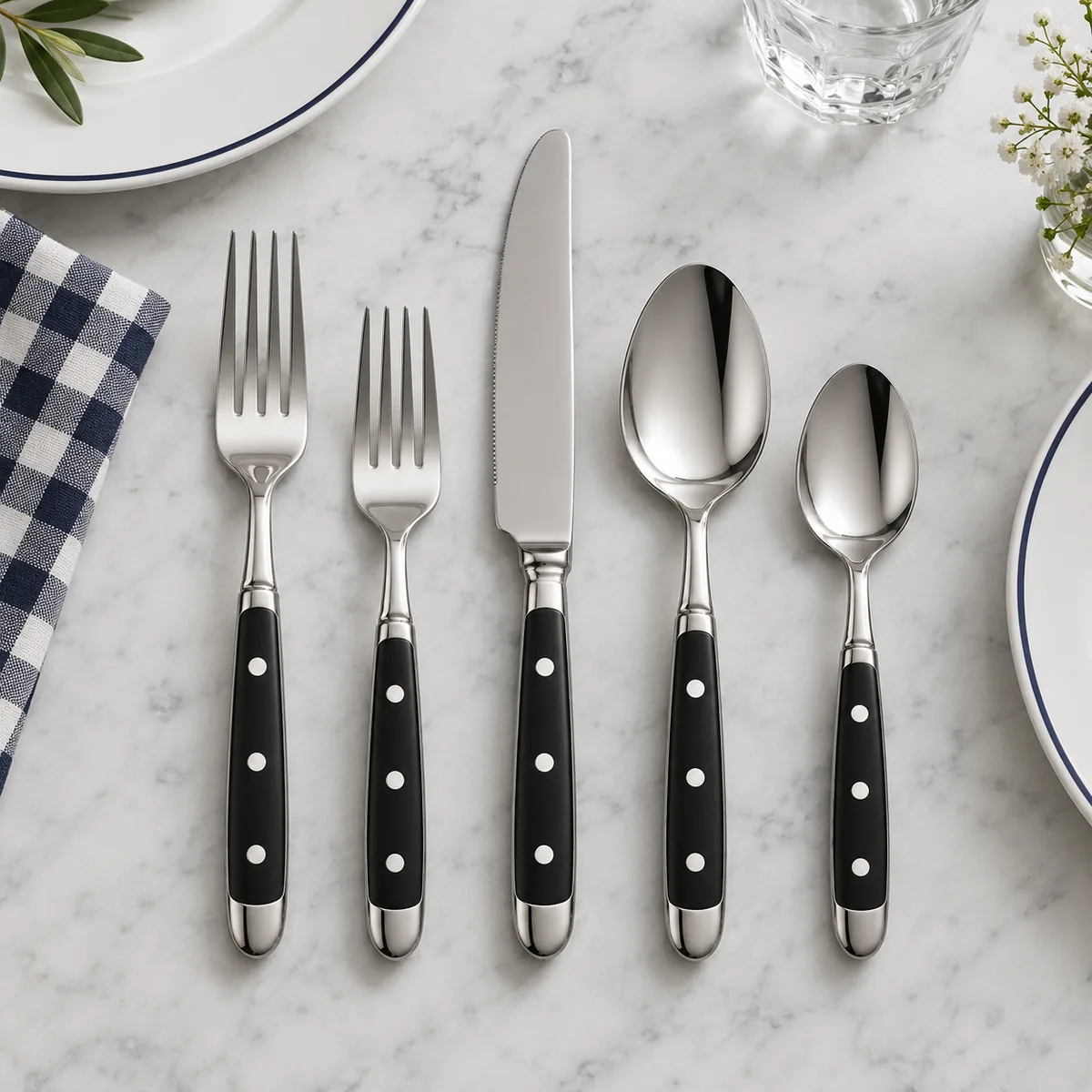
Quick answer: Choose restaurant flatware from the operating brief: menu, service style, pieces, hand feel, wash process, loss rate, storage, replacements and target cost. Approve each SKU from a physical sample and record the final specification before rollout.
Restaurant flatware is an operating tool used hundreds of times, not simply a tabletop decoration. A pattern that photographs well can still slow sorting, feel awkward with the menu, show wash marks or become difficult to replace. The buying process should connect guest experience with dishroom reality and purchasing control.
1. Map the menu to the piece list
Begin with actual dishes. A dinner fork, table knife, tablespoon and teaspoon may cover a casual menu, while steak service, seafood, desserts, espresso or shared plates can require specialty pieces. Remove pieces that staff will not set or guests will not use. Then list opening quantity and replacement quantity by SKU rather than quoting only a five-piece set.
For multi-site groups, use one naming convention across the menu, purchase order, carton label and stock room. This prevents a “dessert spoon” at one site becoming a different size at another.
2. Match dimensions and weight to service style
Fine dining may favor longer proportions and a more substantial hand feel. High-volume cafés and banquets may prefer simpler shapes that stack, carry and sort efficiently. Ask for length, width, thickness and piece weight for every SKU. A family name alone does not prove that the fork, spoon and knife feel balanced together.
Run a live table test with representative plates, bowls and glassware. Check reach, bowl capacity, knife leverage, fork tine function and whether handles slide into food or off the plate rim.
3. Specify material and construction separately
Write the intended stainless direction for spoons and forks and confirm knife construction separately. Alloy shorthand such as 18/10 or 18/0 does not describe thickness, hardness, edge quality, polishing or corrosion performance by itself. Ask the supplier to state the proposed material by piece and identify any construction differences.
4. Select a finish that the operation can maintain
Mirror, satin, stonewashed and colored finishes create different handling and care requirements. Review fingerprints, water spots, rubbing and contact marks under restaurant lighting. If considering PVD color, document the color limit, substrate preparation, wash chemistry and acceptance sample. Do not approve a finish from a screen image alone.
5. Test the dishroom, not only the dining room
Use finished samples in the intended rack, detergent, temperature, rinse, drying and storage routine. Record cycles and observations. Inspect nesting points, tines, bowl edges, knife serrations and colored or textured areas. A controlled trial gives procurement and operations the same evidence.
6. Plan loss, sorting and replenishment
Track loss by piece and service area. Magnetic retrieval may influence material selection in some operations, but suitability depends on the complete specification and equipment. Confirm open-stock availability, stable product codes and whether replacement orders can use the same approved drawings, finish limits and master sample.
7. Compare total operating cost
Compare landed unit cost together with expected life, loss rate, dishroom labor, specialty-piece inventory and replacement lead time. A lower opening price can cost more if the program requires frequent replacement or creates too many slow-moving SKUs.
8. Approve packaging and receiving details
Define pieces per bag or inner, inners per carton, protection between surfaces, labels, barcode needs and carton strength. A receiving team should identify the piece, finish and quantity without opening every pack. For chain rollouts, label by site or shipment wave when required.
9. Send a quote-ready restaurant RFQ
Provide concept, number of sites, covers, service areas, piece list, quantity by SKU, destination, material and finish direction, logo, packaging, wash conditions, required documents and target timing. Ask every supplier to quote against the same fields and mark assumptions. This turns price comparison into a controlled sourcing decision.
Turn this guide into a quote-ready brief
Send destination, quantity by SKU, product reference, material and finish, branding, packaging and target timing. Tongxing can review the brief against real catalog references.
Restaurant Flatware Buying Guide: buyer questions
What flatware pieces does a restaurant usually need?
The answer depends on the menu. Start with the smallest set that covers actual dishes, then add specialty pieces only when service requires them.
How should restaurant flatware samples be tested?
Use every proposed SKU at a live table and through a documented wash, drying and storage trial. Check function, comfort, finish and handling.
Is heavier flatware always better for restaurants?
No. Weight should suit the service style, plateware, staff handling and target cost. Balance and proportions matter as much as total weight.
What information is needed for a restaurant flatware quote?
Send piece quantities, destination, material and finish direction, branding, packaging, wash conditions, target timing and any required documents.
Continue the sourcing research
Specification boundary: Final material, dimensions, finish, performance, packaging, compliance, MOQ and timing must be confirmed in the signed project specification and approved physical sample.