
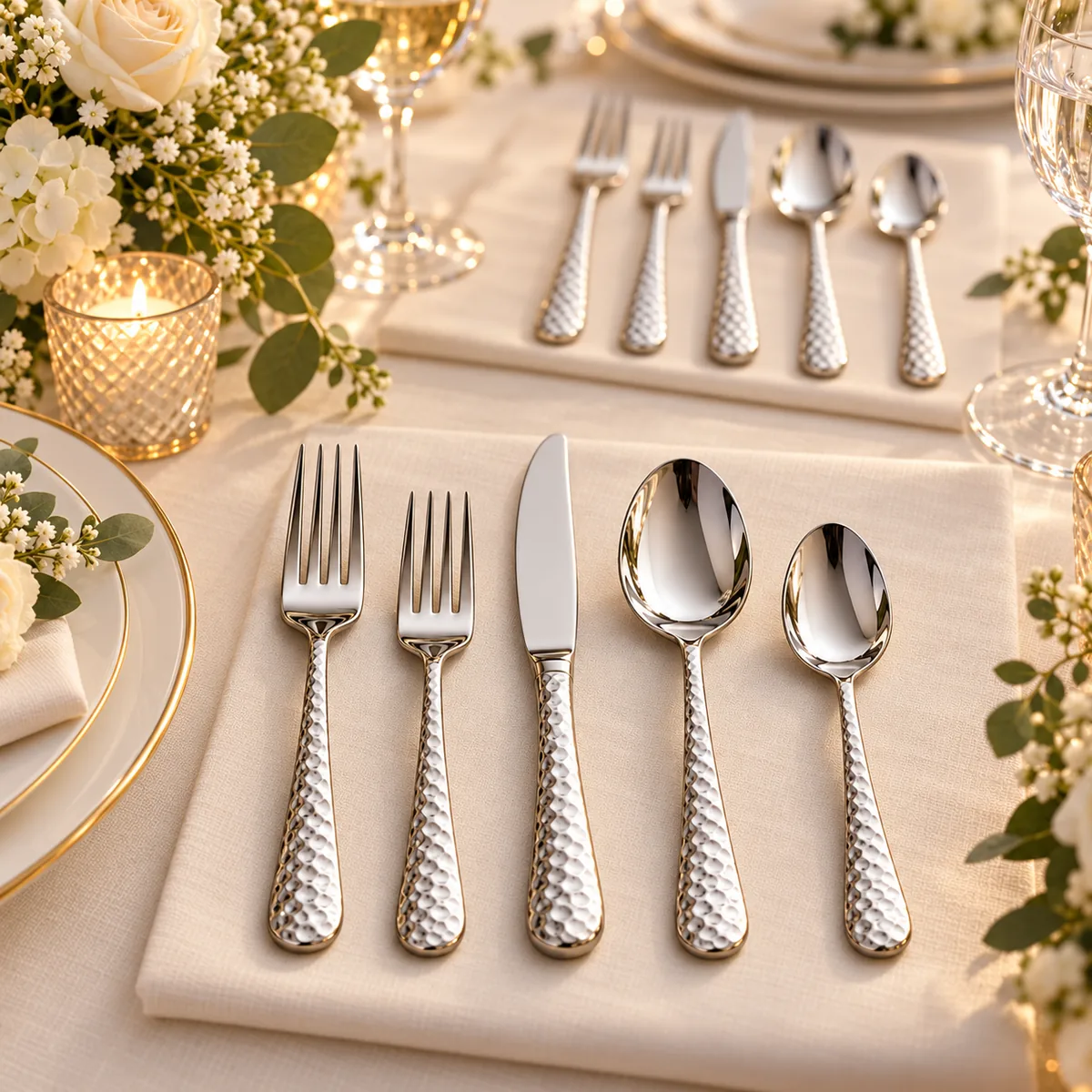
Quick answer: Source hammered cutlery as a controlled texture system, not only as a photograph. Specify where the pattern starts and stops, how deep and consistent it should look, which stainless-steel direction is quoted, the required pieces and finish, and how the complete set must perform in washing, handling and packing.
What buyers mean by hammered cutlery
Hammered cutlery uses repeated dimples, facets or irregular-looking impressions to create texture and reflected highlights. The effect may cover the full handle, a framed center panel or selected decorative zones. It can make a place setting feel more handcrafted, but the commercial specification must still be repeatable.
Search terms such as hammered metal silverware and hammered silverware often refer to silver-colored stainless steel rather than sterling silver. A buyer should never infer the substrate from the word silverware. Ask the supplier to state the proposed material and finish for every spoon, fork and knife component.
Two buyer-ready hammered flatware routes
| Program | Best starting use | What to confirm |
|---|---|---|
| TX-N060 five-piece setting | Restaurant, wedding and hospitality open-stock discussions | Five matching pieces, texture borders, weight direction, replenishment and bulk packing |
| TX-N106 16-piece set | Four four-piece settings for wholesale or private-label retail | Four-piece family, presentation pack, logo, inner protection and transit test |
These references serve different purchasing formats. The five-piece route focuses on a complete place setting and replacement flexibility. The 16-piece route focuses on a defined consumer set and pack presentation. Final commercial availability, specifications, MOQ and timing must be confirmed for the actual project.
Seven checks before requesting a hammered-flatware quote
1. Map the texture on every matching piece
Do not approve only the dinner fork. Review the teaspoon, tablespoon, dinner fork, smaller fork and knife separately. Handle widths and transitions change across the family, so identical tooling language can create visibly different texture density. Mark the start line, end line, border and back-side expectation on drawings or annotated samples.
2. Define acceptable variation
A handcrafted visual does not mean uncontrolled variation. Agree whether the pattern should look regular, random or graduated. Set reference samples for acceptable depth, spacing and high-point brightness. Confirm whether small variation is part of the intended design or a reject condition.
3. Separate material grade from visual finish
Material labels and surface appearance answer different questions. The British Stainless Steel Association explains common cutlery labels including 18/8, 18/10 and 18/0; buyers should still confirm the quoted grade and actual piece construction. A mirror or satin finish can be applied to different stainless-steel directions, while table-knife construction may differ from spoons and forks.
4. Test cleanability in the real wash routine
Texture creates more changes in light and surface contour than a plain handle. Test whether food residue, detergent film or hard-water marks remain visible in recesses. Run the sample through the intended pre-soak, rack, detergent, rinse and drying conditions. Inspect under dining-room light after repeated cycles, not only immediately after unpacking.
5. Compare grip, balance and table contact
Ask several users to handle wet and dry samples. Check whether the texture feels secure without sharp high points, whether the neck and handle balance suit the service style and whether the pieces rock or make unwanted table contact. Decorative appearance cannot replace an ergonomic approval.
6. Approve logo and packaging on the textured product
Logo placement needs a sufficiently controlled surface. Decide whether the mark belongs on a smooth reverse zone, blade, neck or packaging. For a retail set, check that sleeves, trays and ties do not polish the high points or allow adjacent pieces to rub during shipment.
7. Plan replacement pieces and repeat orders
Restaurants lose and replace pieces over time. Record each piece code, approved sample, finish and texture revision. Ask how individual pieces can be reordered and how a later batch will be compared with the master sample. Use the wholesale repeat-order checklist before issuing the first purchase order.
Hammered metal silverware specification table
| RFQ field | Buyer input | Approval evidence |
|---|---|---|
| Product route | Five-piece open-stock setting or packaged 16-piece set | Piece schedule and reference codes |
| Material | Requested grade direction and knife construction | Quotation, material evidence and sample |
| Hammered texture | Coverage, depth, spacing, border and reverse side | Annotated drawing and signed physical sample |
| Finish | Mirror, satin or project-specific color direction | Master sample and viewing conditions |
| Operations | Wash chemistry, temperature, magnetic recovery and service use | Buyer-run wash and handling trial |
| Branding and pack | Logo method, pack count, tray, sleeve and carton | Artwork approval and complete packed-product test |
How 18/8 and 18/10 relate to hammered flatware
The hammered pattern does not prove a material grade. The terms 18/8 and 18/10 are trade labels associated with austenitic stainless directions, but the finished result also depends on thickness, forming, polishing, texture quality and the wash environment. Read the 18/10 versus 18/8 flatware comparison, then request like-for-like samples and documents from suppliers.
The Nickel Institute notes the broad use of nickel-containing stainless steels for hygienic food-contact applications. That background does not certify a specific product. Destination requirements, test scope and compliance evidence must be defined for the quoted item.
Build a comparable wholesale RFQ
Send every supplier the same brief: product reference or image, required pieces, setting format, estimated first-order and annual volume, destination, material and finish direction, texture map, logo, packaging, target timing and required documents. Ask for deviations to be stated rather than hidden inside a similar-looking sample.
Request a hammered-cutlery sample review
Send TX-N060 or TX-N106, your quantity and destination. Add a product photo if you want Tongxing to review another hammered direction.
Hammered cutlery wholesale FAQ
What is hammered cutlery?
Hammered cutlery has a deliberately textured surface made of repeated dimples or facets, usually on the handle. For commercial orders, the buyer should define the texture coverage, depth, border transitions and approved visual sample for every matching piece.
Is hammered stainless steel flatware suitable for restaurants?
It can be suitable when the selected geometry, finish and cleaning routine pass a sample trial in the intended restaurant. Buyers should check grip, food-contact smoothness, recess cleaning, scratch visibility, sorting and replacement availability before approving the program.
Does hammered metal silverware contain silver?
Not necessarily. In many English-language searches, silverware is a general name for table flatware. Commercial hammered metal silverware may use stainless steel with a silver-colored finish. Confirm the exact substrate and finish in the supplier quotation and signed specification.
Which stainless steel grade should a hammered flatware buyer request?
Choose the material direction from the service environment, wash routine, magnetic-recovery needs and commercial target. Do not rely on an 18/8, 18/10 or 18/0 label alone; confirm the quoted grade or composition evidence, piece construction and approved sample.
What should a wholesale hammered-cutlery RFQ include?
Include the product reference, piece mix, setting or bulk-pack format, estimated quantity, destination, material direction, finish, logo, packaging, wash conditions, required documents and target timing. Ask the supplier to quote only after the texture and physical sample requirements are clear.
Sources and interpretation
- British Stainless Steel Association: cutlery stainless-steel grades
- Nickel Institute: food-contact materials
Method note: External sources support general material context. Tongxing product pages are sourcing references. The supplier quotation, signed specification, destination requirements and approved physical sample control the actual order.