
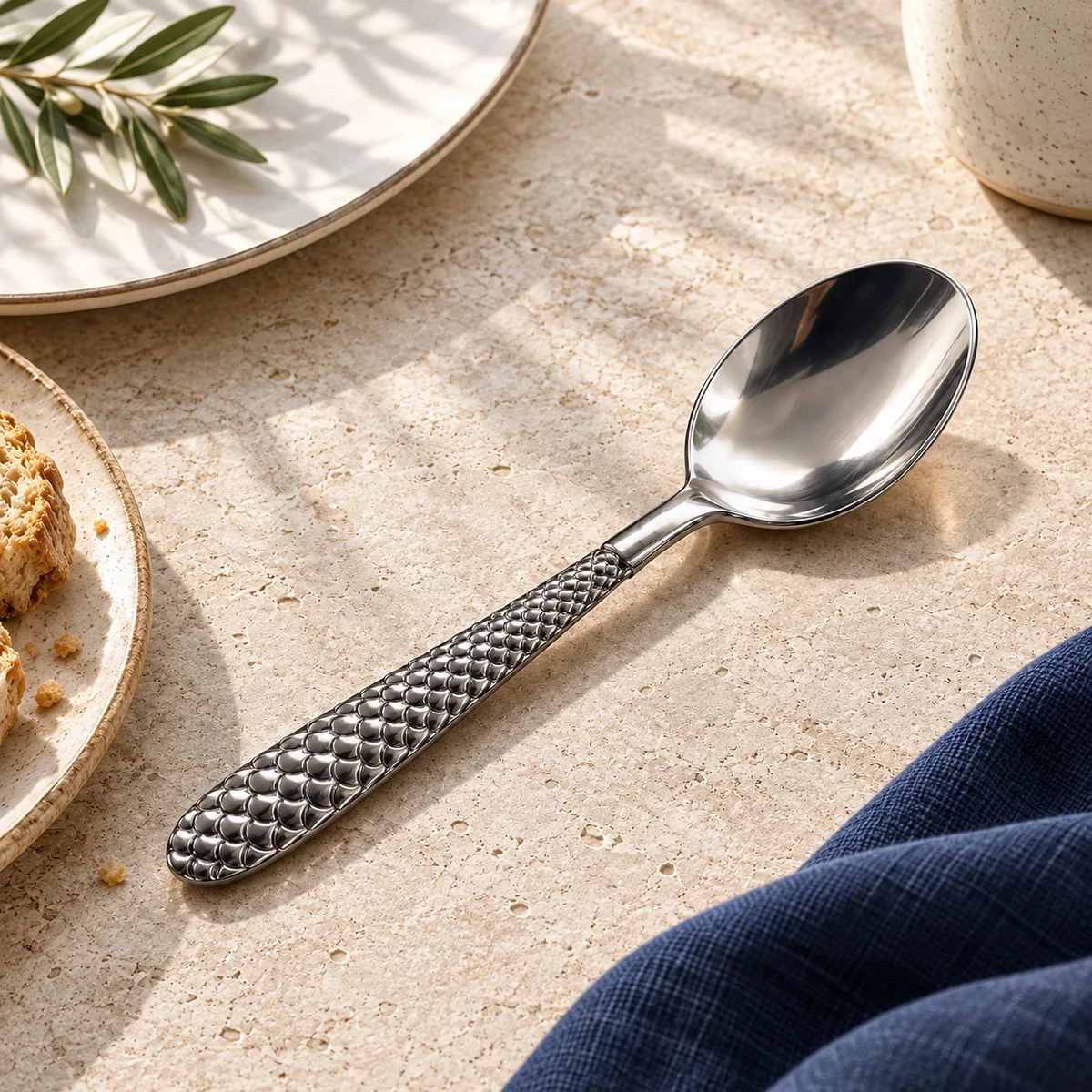
Quick answer: Before flatware production starts, approve 12 controls: product identity, piece mix, drawing, material, dimensions, weight, edges and tines, finish, branding, packaging, inspection plan and revision release. Record each decision in writing and link it to the approved physical sample.
The 12-point flatware pre-production checklist
| Approval check | Evidence to retain | Buyer question |
|---|---|---|
| 1. Product identity | Piece code, set code and current revision | Does every spoon, fork, knife and serving piece have an unambiguous code? |
| 2. Piece mix | Bill of materials and pack count | Are place-setting pieces and shared serving pieces listed separately? |
| 3. Drawing | Signed drawing with revision and date | Which dimensions are critical and how will they be measured? |
| 4. Material | Agreed grade direction and required records | Which material evidence is required for this market and project? |
| 5. Dimensions | Length, width, thickness and tolerance table | Are tolerances stated instead of relying on a catalogue label? |
| 6. Weight and balance | Piece weight direction and approved sample | Which weight variation or balance check will be used at inspection? |
| 7. Edges and tines | Visual and handling criteria | Are burrs, tine alignment, knife edge and food-contact surfaces covered? |
| 8. Finish or color | Physical finish reference and viewing conditions | How will mirror, satin, hammered or PVD appearance be compared? |
| 9. Logo | Vector artwork, method, size and placement drawing | Is the approved logo version tied to the exact piece and orientation? |
| 10. Packaging | Packaging BOM, artwork and carton marks | Does the pack protect finish while matching the commercial count? |
| 11. Inspection plan | Defect classes, sampling plan and required report | Who defines acceptance and what evidence is delivered before shipment? |
| 12. Release control | Signed checklist, sample ID and change log | Who can authorize production and what changes require re-approval? |
1. Create one controlled product definition
A reference photo can start a discussion, but it cannot release production. It does not record thickness, weight, tolerances, material, surface direction, logo placement, pack count or the latest buyer changes. Build one controlled definition that links the current drawing, product code, approved physical sample, packaging files and inspection criteria.
If two references conflict, stop and resolve the conflict before production. The signed drawing may control dimensions while the physical sample controls feel and finish. State that hierarchy in the approval record rather than asking the factory to choose.
2. Measure the features that change the buying result
Do not turn the checklist into a long list of numbers with no commercial purpose. Mark the characteristics that affect fit, service, appearance or replacement compatibility: overall length, bowl or tine dimensions, handle thickness, piece weight, knife construction, balance point and any dimensions connected to a rack, tray or branded package.
For each critical characteristic, record the target, tolerance, measurement method and sample size. A phrase such as “same as approved sample” is useful for feel and appearance, but measurable features should also be written down.
3. Approve finish, logo and packaging as a system
Mirror, satin, hammered and colored surfaces respond differently to handling and light. Approve the exact finish on the exact piece, then define how production pieces will be viewed and compared. For PVD or other colored directions, the physical reference and acceptable range should be agreed before a large lot is made.
Logo approval needs the production method, final artwork version, size, orientation and distance from a repeatable reference point. Packaging approval should identify the product-facing protection, inner pack, retail or bulk count, artwork revision, barcode or label data and carton marks. A beautiful sample can still fail commercially if the packed pieces rub or the set count is wrong.
4. Define inspection before the goods exist
Choose the inspection framework before production so both sides know how a lot will be evaluated. If acceptance sampling is used, record the standard and edition, lot definition, inspection level, defect classes and agreed AQL values. ISO 2859-1:2026 describes AQL-indexed sampling schemes for lot-by-lot inspection; it does not choose the buyer's risk limits for a particular order.
Food-contact surfaces also need usable workmanship criteria. The FDA Food Code describes multiuse food-contact surfaces as smooth and free of breaks, open seams, cracks, chips, pits and similar imperfections. Destination rules and the signed specification remain the controlling requirements for the actual project.
5. Run a pre-production sample review
- Identify the sample: attach a code, revision and approval date so it cannot be confused with an earlier trial.
- Compare documents: check the sample against the current drawing, artwork, finish direction and packaging specification.
- Test the use case: handle the pieces, check table setting and rack or tray fit, and review cleaning expectations for the buyer's service environment.
- Record differences: photograph and measure deviations. State whether each is accepted, corrected or deferred.
- Release or hold: name the approver and release only the version that all documents describe.
Use the sample approval checklist and golden sample guide to build the physical approval record.
A practical review should include people from purchasing, product or design, quality and the operating team that will use or distribute the flatware. Purchasing confirms the commercial scope, product staff check the specification, quality confirms measurable acceptance and the operating team catches service problems such as awkward balance, tray fit or a piece mix that does not match the menu. Record one consolidated decision so the supplier does not receive conflicting comments from different reviewers.
Pre-production release sheet
| Field | What to enter |
|---|---|
| Project | Buyer, destination, use case, target quantity and required timing |
| Product | Piece codes, set code, revision and approved sample ID |
| Specification | Drawing revision, material direction, critical dimensions, weight and workmanship criteria |
| Appearance | Finish or color reference, logo artwork and placement |
| Pack | Piece count, protection, inner pack, carton and artwork revisions |
| Quality | Inspection plan, defect classes, required reports and disposition route |
| Approval | Buyer approver, supplier approver, date, open items and release status |
Send a pre-production review brief
Share one product photo or code, the pieces required, estimated quantity and destination. Tongxing will reply with the missing sample and specification decisions needed before quotation or production review.
Flatware pre-production FAQ
What must be approved before flatware mass production starts?
Approve the product code and revision, signed drawing, material direction, measurable dimensions, piece weight, edge and tine criteria, finish reference, logo artwork and position, packaging specification, inspection plan and an identified physical pre-production sample.
Is a product photo enough to approve a flatware order?
No. A photo can communicate design direction, but it does not control dimensions, weight, material, surface finish, edge condition, logo placement, packaging or revision status. Use a signed specification and an identified physical sample.
How should buyers control changes after sample approval?
Give every drawing, artwork file, packaging file and sample a revision or date. Record the change, the reason, the person who approved it and whether a new physical sample or inspection criterion is required.
Should an AQL be chosen before production?
If the buyer uses acceptance sampling, the sampling standard, inspection level, lot definition, defect classes and AQL values should be agreed before production. The correct plan depends on the buyer's risk and contract; it should not be assumed by the supplier.
What should a flatware pre-production RFQ include?
Send a reference product or photo, required pieces, estimated quantity, destination, target use, material and finish direction, logo and packaging needs, required sample evidence and target timing. Mark unknown fields so they can be resolved during sample review.
Continue the quality-control workflow
- Build the flatware quality-control plan
- Review flatware material records
- Check handle alignment and piece consistency
- Prevent finish scratches during packing and shipment
Specification boundary: Final material, dimensions, finish, performance, packaging, compliance, inspection and quantity terms must be confirmed in the signed project specification and approved physical sample.