
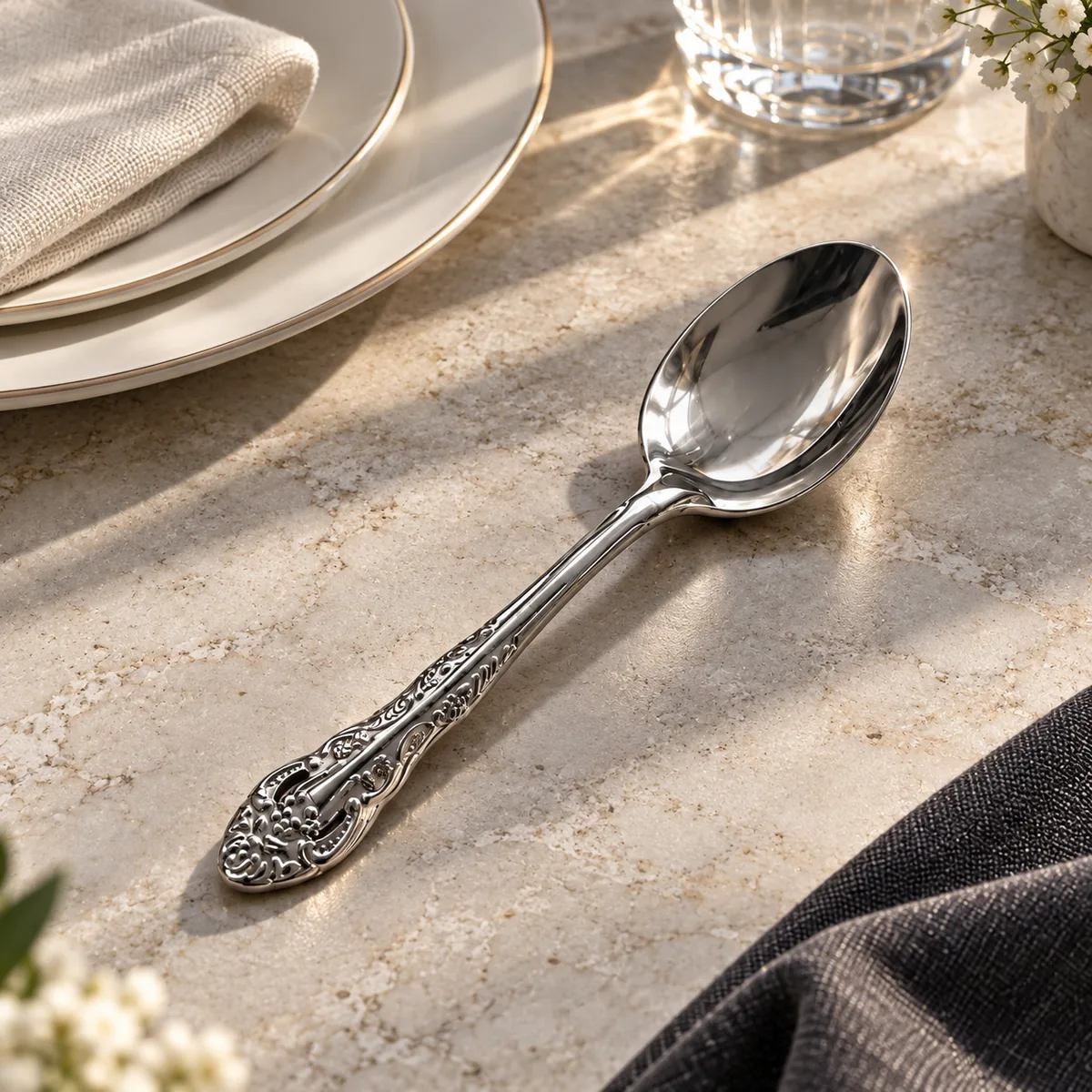
Direct answer: A demitasse spoon is commonly screened at about 4–5 inches (approximately 102–127 mm). That range is a useful starting point rather than a universal standard. The correct commercial size depends on the cup opening, saucer well, bowl clearance, handle balance and service presentation.
What size is a demitasse spoon?
The U.S. Navy Enlisted Aide Handbook describes demitasse spoons as smaller versions of teaspoons used with strong coffee such as espresso or Turkish coffee and gives a general length of 4–5 inches. This is the clearest practical range for an initial supplier discussion, but buyers should not turn it into an automatic pass/fail rule.
Real objects vary. The Metropolitan Museum of Art records one demitasse spoon at 3 5/8 inches (9.2 cm) and another service's demitasse spoon at 4 3/4 inches (12.1 cm). These examples show why the product name alone cannot define a purchase specification.
| Screening reference | Metric equivalent | Buyer interpretation |
|---|---|---|
| 4 in | 101.6 mm | Compact starting point for small cups; verify grip and saucer fit |
| 4.5 in | 114.3 mm | Mid-range comparison sample; verify bowl and handle balance |
| 5 in | 127.0 mm | Longer reference; check overhang and cup clearance |
Not a standard: These conversions support screening. State the exact approved dimension and tolerance on the drawing or specification.
Demitasse spoon, espresso spoon and coffee spoon
Names overlap across markets. The Office québécois de la langue française lists “demitasse spoon” and “coffee spoon” for a very small spoon used to stir a beverage, especially coffee. A supplier may therefore use espresso spoon, moka spoon, coffee spoon or demitasse spoon for nearby products.
Resolve the naming problem with measurable fields. Record overall length, maximum bowl length and width, bowl depth, handle profile, weight or thickness direction, finish and the exact cup-and-saucer reference. If a matched teaspoon is also being sourced, place both samples beside the cup so the buyer can approve the visual hierarchy.
Choose the spoon from the cup and saucer
A spoon can meet the requested length and still fail in service. A wide bowl may collide with a narrow cup opening. A heavy decorative handle can pull the spoon toward the saucer edge. A short handle may disappear into foam or make stirring awkward. A long handle may overhang the saucer and look out of scale.
- Identify the exact cup and saucer used by the target hotel, café or tableware program.
- Place the spoon in the saucer well and photograph its resting position from above and from the side.
- Stir the intended espresso or coffee without striking the rim or forcing the user's fingers against the cup.
- Lift, set down and carry the complete service on the intended tray.
- Record the sample code, dimensions, date and result so the approval can be repeated.
Measure the sample consistently
| RFQ field | How to record it | Why it matters |
|---|---|---|
| Overall length | Tip of bowl to end of handle, in mm | Controls cup and saucer proportion |
| Bowl size | Maximum length, width and depth | Controls stirring clearance and visual scale |
| Handle | Pattern, maximum width and thickness direction | Affects balance, grip and matched-set appearance |
| Material and finish | Proposed grade direction plus mirror, satin or project finish | Prevents a size approval from being reused for a different construction |
| Weight | Target or approved-sample weight with tolerance | Supports repeat-order feel and consistency |
| Fit evidence | Named cup/saucer, photographs and tray trial | Connects dimensions to the real service |
Build the commercial approval around a physical sample
Ask the supplier to label the sample with the product code, revision, proposed material, finish and date. Review edges, symmetry, polish, bowl forming and handle alignment under consistent lighting. Then repeat the cup-and-saucer test with the actual venue or retail tableware.
For a private-label or coordinated program, approve the demitasse spoon beside the teaspoon, dessert spoon and other pieces. The handle pattern can be shared while length, bowl scale and balance remain specific to the espresso service. Keep the approved sample and measurement sheet for repeat orders.
Packaging and service checks
Small spoons can move inside oversized sleeves or inner boxes. Confirm piece count, separators, surface protection and carton movement before approving packaging. For hospitality service, ask staff to load, carry, clear and wash the spoon with the real cup and saucer. A purchasing decision should cover the full handling cycle, not only the table photograph.
Request a size-matched demitasse spoon review
Send the cup and saucer photo, target length or reference sample, quantity, finish, logo, packaging and destination. Tongxing can review the brief before a physical-sample discussion.
Demitasse spoon size questions
What is the standard size of a demitasse spoon?
There is no single universal size. A U.S. Navy hospitality handbook gives a general 4–5 inch range, while documented museum examples measure 3 5/8 inches and 4 3/4 inches. Buyers should specify the required length and approve the spoon with the actual cup and saucer.
How long is a demitasse spoon in millimeters?
A 4–5 inch screening range converts to about 102–127 mm. Treat that as a starting point, not a purchase standard; the quotation should state the exact overall length, bowl dimensions and tolerance.
Is a demitasse spoon smaller than a teaspoon?
Usually yes. It is intended for a small coffee cup and saucer, so buyers should compare the actual demitasse spoon and teaspoon side by side rather than relying only on catalogue names.
Are an espresso spoon and a demitasse spoon the same?
Suppliers often use the names for closely related small coffee spoons, but naming is not a complete specification. Confirm length, bowl shape, handle pattern, cup clearance and the approved physical sample.
What should a demitasse spoon RFQ include?
Include overall length, bowl length and width, target weight or thickness, material direction, finish, handle pattern, logo, packaging, quantity, cup-and-saucer references, destination and the sample acceptance method.
Sources and interpretation
- U.S. Navy Enlisted Aide Handbook: describes demitasse use and a general 4–5 inch length range.
- Office québécois de la langue française terminology record: defines the very small coffee-stirring spoon and records related English terms.
- The Met: William Spratling demitasse spoon: one documented 9.2 cm example.
- The Met: Tiffany flatware service: one documented 12.1 cm example.
These sources establish terminology and reference examples. They do not replace the buyer's signed specification, local requirements or approved physical sample.
Continue the sourcing research
- Dinner fork and spoon size guide
- Café, coffee and dessert spoon planning
- Commercial flatware set composition
Specification boundary: Final material, dimensions, finish, performance, packaging, compliance, quantity and timing are confirmed in the signed project specification and approved physical sample.