
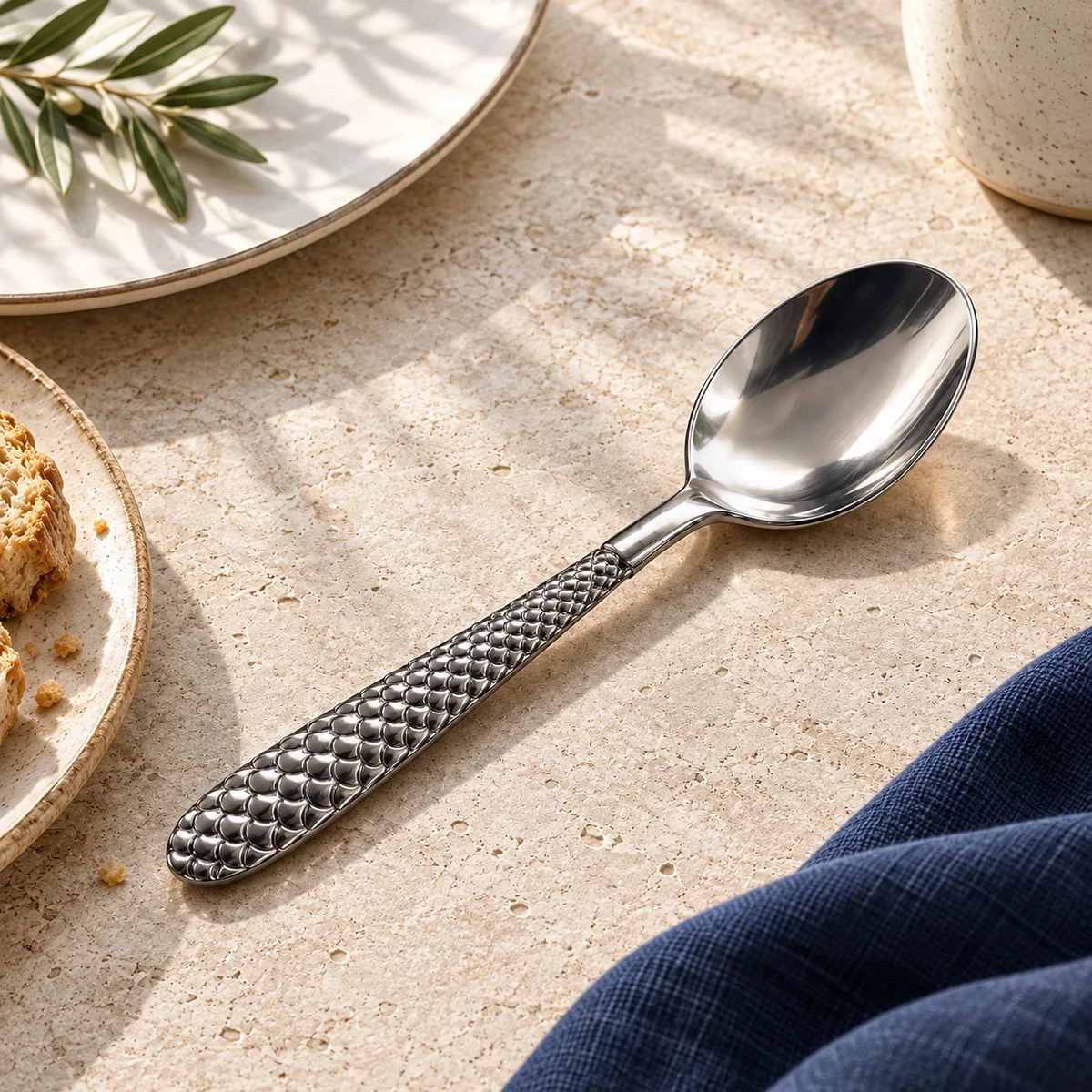
Quick answer: Score shortlisted handles against brand fit, table compatibility, grip, cleaning, family consistency and reorder life so a design meeting produces a documented decision.
Score shortlisted patterns in the same setting
A flatware handle can look strong in a close-up and still conflict with plates, linens or service style. Use a scorecard after the creative shortlist has been made. Review complete place settings, not one isolated spoon, and compare physical samples under the lighting used by the venue or retail display.
Handle pattern scorecard
| Criterion | Review question | Weight |
|---|---|---|
| Brand fit | Does the motif support the intended classic, modern, decorative or minimal position? | Buyer sets 1–5 |
| Table compatibility | Does it work with the chosen plates, glassware, textiles and tabletop distance? | Buyer sets 1–5 |
| Grip and balance | Is the handle comfortable across fork, spoon and knife pieces? | Buyer sets 1–5 |
| Cleaning and polishing | Can relief details be finished and maintained without unwanted sharpness or residue traps? | Buyer sets 1–5 |
| Family consistency | Does the pattern read consistently across narrow and wide pieces? | Buyer sets 1–5 |
| Reorder life | Can the design support the expected program and replacement horizon? | Buyer sets 1–5 |
Use scores to expose disagreement
Have brand, operations and purchasing score independently, then discuss large differences. The number is not the decision by itself; it shows where a visual preference conflicts with handling, cleaning, cost or long-term replacement needs.
For the broader selection method and examples of design families, read how to choose a flatware handle pattern.
Approve the whole piece family
- Review the pattern on at least a fork, spoon and knife.
- Check the transition from handle decoration to the working end.
- Inspect edges and high points after the intended polish or coating.
- Photograph the approved setting and retain coded physical samples.
- Record any accepted variation for future inspection and reorders.
Send the scorecard, preferred pattern references, piece list, finish and target channel with the inquiry. That helps the supplier prepare a relevant sample discussion instead of guessing from a mood image.
Turn this guide into a supplier brief
Send the product code, quantity, destination and the decision factors that matter most. Tongxing can use them to prepare a sample and quotation discussion.
Flatware Handle Pattern Evaluation Scorecard: buyer questions
What should a handle pattern scorecard measure?
Measure brand fit, table compatibility, grip, cleaning, consistency across the piece family and the expected reorder life.
Can handle patterns be approved from photos?
Photos help create a shortlist, but final approval should use physical fork, spoon and knife samples in the intended finish and table setting.
Who should score the samples?
Brand, operations and purchasing should score independently, then resolve large differences and document the agreed decision.
Continue the sourcing research
- Beaded Flatware Handles for Classic Table Settings
- Minimal Flatware Handles for Hotels and Retail
- 18/10 vs 18/0 flatware for hotels and restaurants
Specification boundary: Final material, dimensions, finish, performance, packaging, compliance and quantity terms must be confirmed in the signed project specification and approved physical sample.