
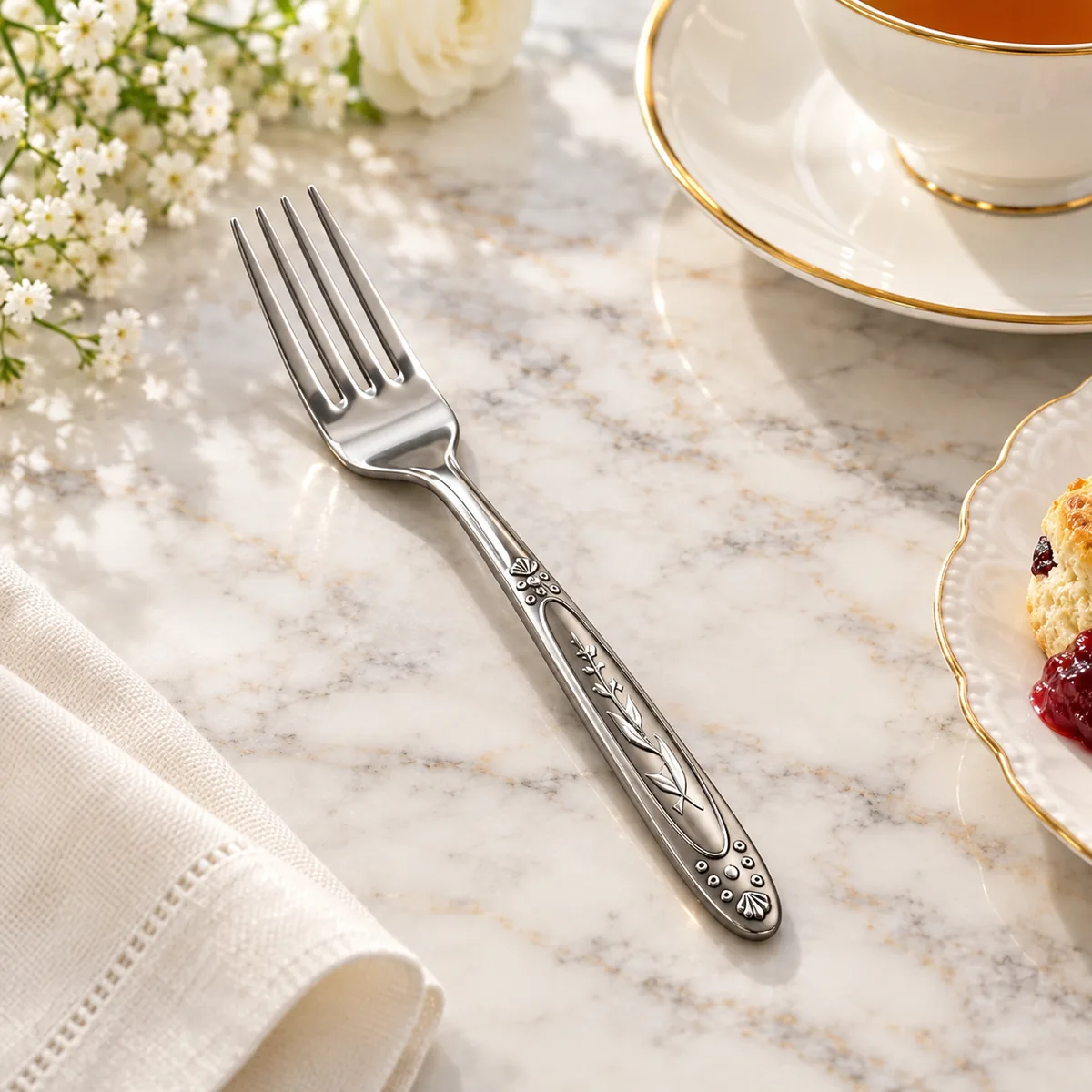
Quick answer: A cake fork is usually a compact fork intended for cake and other plated sweets. “Pastry fork” can mean the same type of piece, or a compact fork with an outer tine shaped to help divide pastry. A dessert fork is often larger and more general-purpose. Because suppliers use these names differently, buy by drawing, dimensions, tine geometry and a tested sample—not by the English name alone.
Prepared by the Tongxing Cutlery OEM/ODM specification team. This guide is for hotel, restaurant, distributor and private-label buyers comparing small dessert pieces.
Cake fork vs pastry fork at a glance
| Point | Cake fork | Pastry fork | Dessert fork |
|---|---|---|---|
| Common use | Cake, tart and small plated sweets | Pastry or cake where the fork may also help divide a bite | General desserts, fruit and courses needing a larger fork |
| Catalog naming | Common in European professional ranges | Used inconsistently across markets | Usually listed as a separate, larger piece |
| Typical scale | Often compact | Often compact, but supplier-specific | Usually closer to a small table fork |
| Head detail | Small fork head; some patterns have a shaped outer tine | May use a widened, flattened or notched outer tine | Normally a conventional fork profile |
| Buying rule | Approve the exact overall length, head width, tine profile, material, finish and physical sample. | ||
The names are not a reliable specification
Professional catalogs demonstrate why the product name alone is insufficient. Eternum lists a cake fork and a dessert fork as separate pieces within the same collections. In several examples, cake forks are roughly 140–155 mm while the coordinated dessert forks are roughly 180–192 mm. WMF Professional also treats “cake fork” as its own product category across many collections. These catalogs establish a useful market pattern, but they do not create a universal dimensional standard.
“Pastry fork” is less consistent. Some buyers use it as a synonym for cake fork. Others expect a functional outer tine that can press through a tart shell or divide a soft pastry. Translation can add another layer: one catalog may map several local-language piece names to a single English label. Put the intended food and geometry into the RFQ so both parties are discussing the same object.
What should the outer tine do?
A shaped outer tine can act as a small cutting edge when the guest holds the fork in one hand. Depending on the design, that tine may be wider, flatter, slightly beveled or notched. The feature should divide the target dessert without feeling sharp against the mouth, bending during use or creating a difficult-to-polish corner.
Do not approve this feature from a front-view rendering alone. Ask for close photographs of both faces and the edge transition, then test the sample with the actual menu: sponge cake, cheesecake, tart crust, laminated pastry or fruit. Record whether the fork pierces cleanly, portions the food, releases the bite and remains comfortable.
Size and proportion checks for hospitality buyers
Start with the dessert plate and service style. A compact cake fork can look balanced beside a small afternoon-tea plate, but it may feel undersized for a broad restaurant dessert plate. A larger dessert fork may simplify operations because it covers more menus, yet it loses the specialized presentation of a cake fork.
- Overall length: record the finished millimetres on the drawing.
- Head width and length: compare the fork visually with the dessert plate and cake portion.
- Tine count, spacing and tips: check food pickup, polishing and mouth comfort.
- Outer-tine geometry: specify which side is widened or shaped and how it should perform.
- Handle proportion: coordinate the small piece with the table fork, teaspoon and pattern family.
- Weight and balance: avoid a decorative handle that makes the short fork feel tail-heavy.
When one dessert fork is the better commercial decision
A restaurant or hotel does not automatically need a specialized cake fork. One coordinated dessert fork may be the better choice when it must serve cake, fruit, starters and other small courses; when staff sorting time matters; or when replacement inventory should stay simple. A cake or pastry fork earns its separate SKU when the presentation is central to the concept, the menu uses it frequently, or the cutting-tine function has been proven in service.
Estimate the operational cost before adding the piece: opening quantity, par level, washing and sorting, storage slots, replacement stock and the risk of mixing similar forks. The most attractive sample is not automatically the most economical program.
Sample test: five desserts, one scorecard
Use the same five-step test for each candidate. Select representative foods—such as sponge cake, cheesecake, tart, flaky pastry and fresh fruit—and serve them on the target plate. Score each fork for piercing, cutting assistance, bite pickup, comfort and plate proportion. Photograph the sample beside a ruler and record total length, head dimensions and weight. Keep the approved result with the product code and revision.
A failed result should be specific. “Outer tine drags through tart shell,” “tips are too blunt for fruit,” or “handle is too heavy for the short head” gives a supplier something that can be reviewed. “Does not feel premium” does not.
Cake and pastry fork RFQ checklist
- State the intended name in the selling market and describe the actual food task.
- Give the overall length, head length and width, tine count, spacing and outer-tine profile.
- Define the material direction, thickness or weight target and mirror, satin or color finish.
- Identify the coordinated handle pattern and the other pieces in the range.
- State quantity, destination, logo, packaging and any food-contact documentation required.
- Request a coded physical sample and define the plate-and-food approval test.
- Keep the signed drawing and approved sample as the repeat-order reference.
Ask Tongxing to develop the dessert piece
Send a photo or sketch, target length, menu use, quantity and destination. Tongxing can review the fork head, handle direction, finish, logo and packaging for a project-specific sample discussion.
Source notes
- Eternum Soft professional cutlery collection — shows separate cake-fork and dessert-fork references with dimensions.
- Eternum Baguette collection — another coordinated range with separate piece codes and sizes.
- WMF Professional cake-fork category — shows cake forks as a distinct professional cutlery category.
Frequently asked questions
Are cake forks and pastry forks the same?
Sometimes. Catalog naming is not universal. Many suppliers use cake fork for a compact dessert piece, while pastry fork may describe the same function or a fork with a stronger cutting tine. Compare the drawing, length and tine geometry rather than accepting the name alone.
What size is a cake fork?
Professional cutlery catalogs commonly show cake forks around 140 to 155 mm, while coordinated dessert forks in the same collections can be around 180 to 192 mm. These are catalog examples, not a universal standard, so the ordered dimension must appear on the approved drawing.
Why does a pastry fork have a wider tine?
Some pastry or cake-fork designs widen, flatten or notch an outer tine so it can help divide soft pastry with the side of the fork. The feature is not universal and must be tested with the intended dessert.
Can a dessert fork replace a cake fork?
Yes for many casual programs, especially when reducing SKU count matters more than a specialized presentation. Test reach, plate proportion and cutting performance before standardizing one piece.
What should a buyer include in a cake-fork RFQ?
Specify the catalog name and intended food, overall length, head width, tine count and profile, material and finish direction, handle pattern, quantity, destination, logo, packaging and sample-approval method.
Continue the sourcing research
- View the TX-N006 fork-handle reference →
- Compare a second real fork-handle reference →
- Review fork-tine cutting and finishing checks →
- Plan the commercial piece mix →
Specification boundary: Market names and catalog dimensions are reference evidence. Final material, dimensions, tine geometry, finish, performance, packaging, compliance and quantity terms must be confirmed in the signed specification and approved physical sample.